
Sermon for 3/20/11
Lent 2A
“Earthly Things” “Heavenly Things”

As a kid, I loved Sesame Street. In fact, I still like Sesame Street, and have an ongoing affinity for anything Muppets. Kermit has always been my favorite.

This loveable green frog hails from a swamp, where he had thousands of tadpole siblings, and has gone on to made it big in Hollywood as a movie star, or so his biography reads. [1] As one of the most famous Muppets, he is recognizable to many thanks to his famous song, “It’s not easy being green”, and he even has his own star on the Hollywood Walk of Fame. He’s also one of the most famous frogs in the world, at least I can’t think of any other well-known frogs. Frogs are amphibians since they are born in the water as tadpoles and then transform into land animals as they mature. So not only is Kermit one of the most famous frogs in the world, he might just be the most famous amphibian in the world as well. Hold this thought; we’ll come back to this again in a moment.
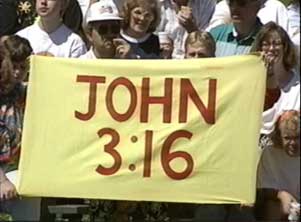
A verse from today’s Gospel reading from John might just be one of the most famous Bible passages in the world as well. The title “John 3:16” is seen on billboards along the road, printed on signs people hold up at stadiums, and even seen painted on people’s faces. It’s a verse I remember having to memorize as a kid in Sunday School … “For God so loved the world that he gave his only Son, so that everyone who believe in him may not parish but have eternal life.” This is a good verse to remember, but let’s spend a few minutes looking into the passage that surrounds it to better understand the context and what Jesus is sharing with us.
The passage from Johns’ Gospel that we heard today tells the story of Jesus’ encounter with Nicodemus, a Pharisee and leader of the Jews. He travels to Jesus to ask questions of the great teacher (Rabbi in Hebrew). It’s a passage of questions and answers, though the answers seem to not be what Nicodemus was expecting to hear.
Lent is a season that invites us to ask questions. Questions about God and questions about ourselves. Frederick Buechner writes, “After being baptized by John in the Jordan, Jesus went off alone in the wilderness where he spent forty days asking himself the question what it means to be Jesus. During Lent, Christians are supposed to ask one way or another what it means to be themselves.” [2] As I’ve contemplated this well known passage, I’ve heard this conversation between Nicodemus and Jesus to be one that asks questions about what it means to be a Christian–a follower of Jesus. Jesus hears Nicodemus’ question about how Jesus can do the signs from God and answers it by telling him what it means to enter the Kingdom of God and be a follower of God? What does it mean to be ourselves, now that we’ve encountered Jesus? Nicodemus is asking this kind of question, and from his response, the answer was not one he was expected or fully understood.
Jesus’ answer invites Nicodemus, and all of us as well, to become people who are open to the work of the Spirit to be born from above– to be born of both water and Spirit. It is an invitation to become people who are open to the work of God in and through our lives. [3] It is an invitation to become Kingdom of God people; people who live both earthly and heavenly lives; people who are always watching for God’s presence in the world, and when they see the effects of the Spirit at work, want to show others where God is at work around us.
As I have read this passage over and over, I notice that Jesus’ response to Nicodemus is not an either be born again or born from above, but a both/and. The word in Greek that is translated “born again” or “born from above” means both of these as well as “born anew”. It’s not either/or. [4] Scholars believe Jesus used this word for that very reason, though Nicodemus got stuck fixating on the one meaning he heard. Jesus also says we are to be born of water and Spirit. Not one or the other, but both. Jesus goes on to describe the movement and work of the Spirit in terms of the wind, since the Greek word can mean Spirit, wind, and breath. We know the wind is there and sense the movement of the wind in the same way we sense the movement of the Spirit. We may not see the Spirit visibly, but we know where the Spirit is at work blowing around us.
Born from above, born anew, born again… born of water and the Spirit… what is Jesus saying? What is he asking Nicodemus? As I mentioned a minute ago, I believe Jesus is inviting Nicodemus into the journey of discipleship to begin to see the Kingdom of God’s presence in his daily life. This journey is one that each of us is invited into as well. During Lent, it is good for us to explore this journey of discipleship because we must ask the tough questions about what it looks like to be a water and Spirit, born again-above-anew disciple. What does it look like to have one foot in the earthly things of life and the other stepping into the heavenly things of God and hold both of these together at the same time?
Jesus showed us this life in everything he did. He is the ultimate example of earthly-heavenly living. He is God-incarnate who came from heaven and became flesh and pitched his tent and moved into the Neighborhood as John 1 reminds us. [5] He is inviting each of us to try our best to live out his example in our own lives as well. Keep our eyes fixed on God and name where God is at work around us—focus on heavenly things and not neglect the earthly things as well. Live lives that are both-and—lives of water and Spirit. Live lives that make others stop and ask us why we are living that way, and we then have the wonderful opportunity to answer their questions and point out where we see God at work around us to identify God’s Kingdom here.
Maybe we can relate to Nicodemus, though. Maybe we are here in Lent asking these tough questions and are still not sure what Jesus means. How do we do that? How is it even possible? What does he mean be born of water and Spirit? How can we live lives on earth and in heaven at the same time? These may seem contradictory or paradoxical. As I thought about these questions this week, I wondered what examples we have where this type of living is possible, since it seems counter to our human understanding. Then it hit me. We are called to be amphibians. [6] Maybe everything I need to know I learned on Sesame Street, and maybe Kermit the Frog has something to teach us about being a disciple.

We are called to live lives of both water and Spirit. The word Amphibian in Greek means living on both sides of life and originally meant anything with two natures combined together. [7] This paradox of living in two worlds does exist in our world, and maybe Kermit can serve as a reminder for us that we are called to this life as well .
How might we live into our amphibian calling from Christ? How might we take this time during Lent to live into the earthly and heavenly worlds and follow the blowing of the Spirit in our daily lives? These Lenten days present us with an opportunity to focus our minds and hearts on God in ways that can help us remember God and seek to see the Spirit’s work in our lives. And hopefully by seeing God at work around us, we can continue to live into this dual-life as earthly and heavenly followers of Jesus, and help us to venture from the swamp into the Kingdom of God.
Maybe this earth and heaven connection involves us choosing to eat lunch with a colleague who’s been going through a rough time and offering a listening ear and even maybe a prayer for them as you look together to see where God is at work in their situation. Or maybe being an amphibian disciple involves sitting with someone on the bus on the way to or from school that looks lonely and in need of a friend. Maybe it involves listening to that voice inside encouraging you to visiting a shut-in you’ve been meaning to go see or making that phone call to an old friend to just to say hi and check in with them, or sending that get well or sympathy card that you’ve meant to send just to let someone know God cares and so do you.
For my Lenten discipline this year, I chose to take on the practice of looking for God each day and then blogging about it. It is often simple things that make me stop and notice the Spirit moving by me like the wind. It often has come in conversations with friends or a picnic lunch with the MYF youth last Sunday on a beautiful spring day. I saw the Spirit at work in the Bear Cub scouts and Parents that I spent time with last Tuesday as they worked to complete their “God and Me” program. By looking for these “Holy in the Ordinary” moments [8], I hope and pray that God is working in me to make me more amphibious. I believe it is true, and I look forward to Easter and the chance to look back over my 40 days of Lent and see how God has been moving in my life. If you haven’t chosen a Lenten Discipline yet, or you are willing to make room in your day, I invite you to join me. Tell a friend where you’ve seen God during the day or post it as a comment on my blog–you can find a link in my email signature—LivingOnEmmausAve.wordpress.com.
Let’s watch and look, and together see how Jesus is leading us to become more and more amphibious this Lent. It’s not easy being Green, Kermit reminds us, but by the end of his song, he decides that being green isn’t so bad after all. Maybe Lent will help us feel the same about being disciples who are on a journey to discover more and more how to live earthly and heavenly lives, it’s not easy, but it’s not so bad after all. In fact, maybe being amphibious it’s the only way we can live.
[1] http://muppet.wikia.com/wiki/Kermit%27s_Family
http://muppet.wikia.com/wiki/Kermit_the_Frog
[2] Frederick Buechner, Whistling In The Dark: A Doubter’s Dictionary (NY: HarperSanFrancisco, 1993) 82.
[3] Deborah J. Kapp, “Pastoral Perspective” in Feasting On The Word, Year A, Vol. 2, eds. David L. Bartlett and Barbara Brown Taylor (Louisville, KY: Westminster John Knox Press, 2010) 70.
[4] The word in Greek is anothen. Translators choose on or the other since English doesn’t have an equivalent word that carries all of these meanings. Karoline M. Lewis “Exegetical Perspective” in Feasting On The Word, Year A, Vol. 2, eds. David L. Bartlett and Barbara Brown Taylor (Louisville, KY: Westminster John Knox Press, 2010) 71.
[5] John 1:14 The Message Translation
[6] “Sermon Fodder” by Lindy Black, http://web.me.com/lindyblack/Sermon_Fodder/Lectionary/Entries/2011/3/20_LENT_2A.html
[7] http://en.wikipedia.org/wiki/Amphibian
[8] Ann Weems, “Holy In The Ordinary”, Kneeling In Jerusalem (Louisville, KY: Westminster John Knox Press, 1992) 13. This is the Poem that inspired my Lenten Practice this year.
 Living On Emmaus Ave