
Sermon for 10/19/2014
Guest Preacher at First Moravian Church in Greensboro, NC
Proper 24, Year A/19th Sunday After Pentecost
Isaiah 45:1-7; Matthew 22:15-22
“Seeing A Different Way”
I’m willing to take a guess that I’m not the only one here this morning that is tired… tired of political commercials, that is. Are any of you like me and just ready for those cute Christmas Commercials to start and the political ads finally to come to an end? (RAISE HANDS) I am usually one that dislikes Christmas celebrations starting before Advent, but this year, I am waiting with eager anticipation to see those cute Hershey Kisses bells play “We Wish You A Merry Christmas!” They can’t get here soon enough.
The political commercials flooding our lives right now remind us we live in a political world. We are surrounded by it. Left, Right, Conservative, Liberal, Republicans, Democrats, and everything in between. It’s on TV, the radio, in print media, on Facebook, and it’s hard to escape. It is a part of our daily lives, and times like now as the election day looms near remind us just how true this is—politics are a part of our world. This may seem like a modern invention, but in reality, our world has been under the influence and effects of politics since the beginning.
Matthew’s text this morning may look like a debate about money on the surface, and it certainly involves money, but it is also a very political text. This text brings together the Pharisees and the Herodians in the same scene. These two groups were arch-enemies—like Carolina and Duke or Republicans and Democrats today. The only thing they held in common was a desire to get Jesus out of the picture. With their common enemy of Jesus, we see them working together to trap him in a corner.
Jesus is in a lose-lose situation in today’s passage. They ask him, “Tell us then, what is your opinion? Is it right to pay taxes to Caesar or not?” The Pharisees were Jews who held strictly to the Jewish law. They despised Rome’s leadership of their region. If he answers “Caesar” the Pharisees will accuse him of breaking the religious laws and denouncing the Great Commandments.
The Herodians, on the other hand, were Jews who supported the Roman Emperor or Caesar and their local leader, likely Herod Antipas. If Jesus answers “God”, the Herodians will accuse him of sedition—or trying to get people to rebel against the government. It’s a political question with political implications. Either way he answers riots would ensue. He’s between a rock and a hard place. It’s like they are asking him to choose which color blue is his favorite: Carolina or Duke, or whether he will vote for the liberal or the conservative. Neither answer will satisfy the whole crowd. He’s going to upset someone either way!
That’s when the remarkable happens. Jesus takes this difficult situation and turns it on its head. His answer “Give to Caesar what is Caesar’s and to God what is God’s” is radical. It moves the conversation in a totally new direction that allows Jesus to step out of the corner the Pharisees and Herodians had him backed into. He uses the contrast to answer their question, get out of the trap they set for him, and left his listeners amazed. The unexpected happened, and Jesus was able to show his listeners a radically different way that was neither a win nor loss for the two sides. It was a different way of thinking that they were not expecting. Jesus’ answer was seeking a different way of living. It is very much like the four young men in Greensboro who sat at a lunch counter and were able to change the world through non-violence. They sought a different way of living that we still see rippling through our world today.
The Isaiah text we heard this morning also presents a political message that is unexpected. This section of Isaiah was written when the Jews are being held captive in Babylon likely just before they were able to return to their homeland in Jerusalem. They are looking for God’s divine intervention to get them out of a very difficult situation—being slaves in a foreign land. The Prophet Isaiah is writing the words from God that Cyrus will be strengthened by God to be the one to deliver the people back to their homeland.
The interesting thing about Cyrus that the text does not make clear in this passage is exactly who Cyrus was. We know from history that Cyrus was the emperor, and not just any emperor, but the Emperor of Persia—or modern day Iran. He was very powerful and his empire was immense. He was not a Jew. He was a foreigner. It even says in verse 4 that “you do not acknowledge me” (NIV) or “you do not know me” (NRSV). Emperor Cyrus did not worship the God of the Jews, and yet God was able to use him to bring about God’s work. Cyrus is called God’s anointed, or Messiah in Hebrew, because he is accomplishing God’s work on earth. It is the only time in the whole of Scripture that a non-Jew is called a Messiah, and that title at the time carried a lot of social and political weight. (1)
God wants to bring about God’s kingdom on earth, and is willing to work through politics, society, leaders, and every day citizens like you and me to bring about a better, more kind, and more peaceful world. God worked through the prophets and leaders in Biblical times, and God worked through the life, death, and resurrection of God’s son Jesus Christ to teach us what heaven on earth might look like. And God continues to work in mysterious ways even today.
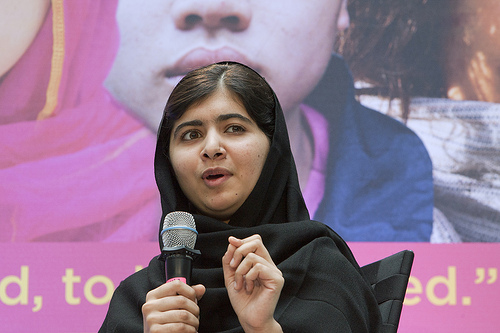 The world received word this past week about who the Nobel Peace Prize winners are for this year. One of these two individuals is Malala Yousafzai. She is Pakistani girl who was shot in the head by the Taliban for her fight for girls’ education and survived. Malala is a remarkable young woman, and the youngest ever Nobel Prize winner, who is seeking a different way in this world for the sake of the world. She shares the award with Indian children’s advocate Kailash Satyarthi, who works diligently to end child slave labor.
These two individuals are about as different as can be. They from countries that are often at odds with one another, they practice different religious—Malala is Muslim, while Kailash is Hindu, and they are young and old, female and male. And yet they will stand together and receive the Nobel Peace Prize together in December. In her speech after learning of her award, she thanked Allah, and promises to continue her work toward peace and education for all children in the world. I encourage you to watch her speech on Youtube this week. It is well-worth your time. She and Kailash have both invited their countries’ Prime Ministers to join them for the award ceremony and a time for these world leaders to speak to one another and work for a shared peace.
I read her autobiography, I Am Malala, over the summer, and was just continually amazed her prophetic words of wisdom, courage, justice, peace, and desire for education. I highly recommend the book both to learn about this remarkable 17-year-old and also to understand much about the history and culture of Pakistan, since it plays a role in our current events today. I truly believe she is one like Emperor Cyrus whom God is using to bring about God’s Kingdom on earth, whether she knows or acknowledges it. She is seeking a different way in our world, and refused to sit in the corner silently. She desires to be a politician and work for peace when she is older, and that’s one political commercial I look forward to watching.
Here are some words from Malala herself that she shared this past week (in an email to followers of her Malala Fund). She said,
“Today, I was honoured to learn I will receive the Nobel Peace Prize.
I am proud I am the first young person and first Pakistani to win this prize. It is an honour I share with Kailash Satyarthi– a hero in the fight for children globally. More than ever, our world needs more heroes like Kailash.
I believe the Nobel committee didn’t give this award to me. I believe they have done this because they believe education is the best weapon through which we can fight poverty, ignorance and terrorism. …
The road to education, peace and equality is very long. But I know millions of children are walking beside me. If we go together, we will achieve our goals and we will complete our journey. We have to walk together.
I am honoured to walk this road with Kailash. I am honoured to walk it with you.
With Gratitude and Hope,
— Malala”
May we all continue to seek a different way like Jesus, like Cyrus, and like Malala today. May we follow the Spirit’s mysterious work among us that leads us to find ways to bring about God’s Kingdom on earth—a Kingdom of peace and justice. A Kingdom of different ways that we can imagine—a Kingdom that don’t leave us stranded in the corner but instead allows us to find common ground to work together for love. A Kingdom that is based on love of God, love of One Another, and love of Ourselves. May we unite our hearts and seek a different way together. Amen.
(1)Jay Emerson Johnson, “Isaiah 45:1-7 Theological Perspective” in Feasting on the Word, Proper 24, pg. 170.
Photo Credit: World Bank Photo Collection via photopin cc
 Living On Emmaus Ave